Today, the first Sunday in Great and Holy Lent, the Church commemorates the triumph of Orthodoxy—the restoration of the veneration of icons by the Seventh Œcumenical Council.
The feast was first kept on the first Sunday in Lent, 11 March 843, when the Empress Theodora re-proclaimed the decree of the 7th Œcumenical Council of 787 commanding the veneration of icons, which had been ignored by iconoclast emperors since 814. The restoration of the veneration of icons following the iconoclast controversy has become the type or symbol of the triumph of orthodoxy over heresy.
The iconoclasts claimed that the Mosaic prohibition, ‘Thou shalt not make unto thee any graven image, or any likeness of any thing that is in heaven above, or that is in the earth beneath, or that is in the water under the earth,’ (Exodus 20: 4) forbade icons.
St John Damascene replied, ‘Human nature was not lost in the Godhead but, just as the Word made flesh remained the Word, so flesh became the Word remaining flesh, becoming, rather, one with the Word through union. Therefore I venture to draw an image of the invisible God, not as invisible but as having become visible for our sakes through flesh and blood. I do not draw an image of the immortal Godhead—I paint the visible flesh of God …’ (First Apology for Images, 5–6)
The iconoclasts, forbidding the iconising of Christ, were denying that Christ had become at once True Man and True God, as was necessary for our salvation. They therefore repudiated the orthodox Christian faith.
Ever since, this day has been kept as the Feast of Orthodoxy. During the Vespers service, icons are carried in procession and the Synodikon of the Seventh Œcumenical Council condemning all heresies is read:
‘As the Prophets beheld, as the Apostles taught, as the Church received, as the Teachers dogmatized, as the Universe agreed, as Grace illumined, as the Truth revealed, as falsehood passed away, as Wisdom presented, as Christ awarded:
Thus we declare, thus we assert, thus we proclaim Christ our true God and honour His saints in words, in writings, in thoughts, in sacrifices, in churches, in holy icons, on the one hand, worshipping and reverencing Christ as God and Lord, and on the other hand honouring and venerating His Saints as true servants of the same Lord.
‘This is the Faith of the Apostles, this is the Faith of the Fathers, this is the Faith of the Orthodox, this is the Faith which has established the Universe.’
The feast was first kept on the first Sunday in Lent, 11 March 843, when the Empress Theodora re-proclaimed the decree of the 7th Œcumenical Council of 787 commanding the veneration of icons, which had been ignored by iconoclast emperors since 814. The restoration of the veneration of icons following the iconoclast controversy has become the type or symbol of the triumph of orthodoxy over heresy.
The iconoclasts claimed that the Mosaic prohibition, ‘Thou shalt not make unto thee any graven image, or any likeness of any thing that is in heaven above, or that is in the earth beneath, or that is in the water under the earth,’ (Exodus 20: 4) forbade icons.
St John Damascene replied, ‘Human nature was not lost in the Godhead but, just as the Word made flesh remained the Word, so flesh became the Word remaining flesh, becoming, rather, one with the Word through union. Therefore I venture to draw an image of the invisible God, not as invisible but as having become visible for our sakes through flesh and blood. I do not draw an image of the immortal Godhead—I paint the visible flesh of God …’ (First Apology for Images, 5–6)
The iconoclasts, forbidding the iconising of Christ, were denying that Christ had become at once True Man and True God, as was necessary for our salvation. They therefore repudiated the orthodox Christian faith.
Ever since, this day has been kept as the Feast of Orthodoxy. During the Vespers service, icons are carried in procession and the Synodikon of the Seventh Œcumenical Council condemning all heresies is read:
‘As the Prophets beheld, as the Apostles taught, as the Church received, as the Teachers dogmatized, as the Universe agreed, as Grace illumined, as the Truth revealed, as falsehood passed away, as Wisdom presented, as Christ awarded:
Thus we declare, thus we assert, thus we proclaim Christ our true God and honour His saints in words, in writings, in thoughts, in sacrifices, in churches, in holy icons, on the one hand, worshipping and reverencing Christ as God and Lord, and on the other hand honouring and venerating His Saints as true servants of the same Lord.
‘This is the Faith of the Apostles, this is the Faith of the Fathers, this is the Faith of the Orthodox, this is the Faith which has established the Universe.’
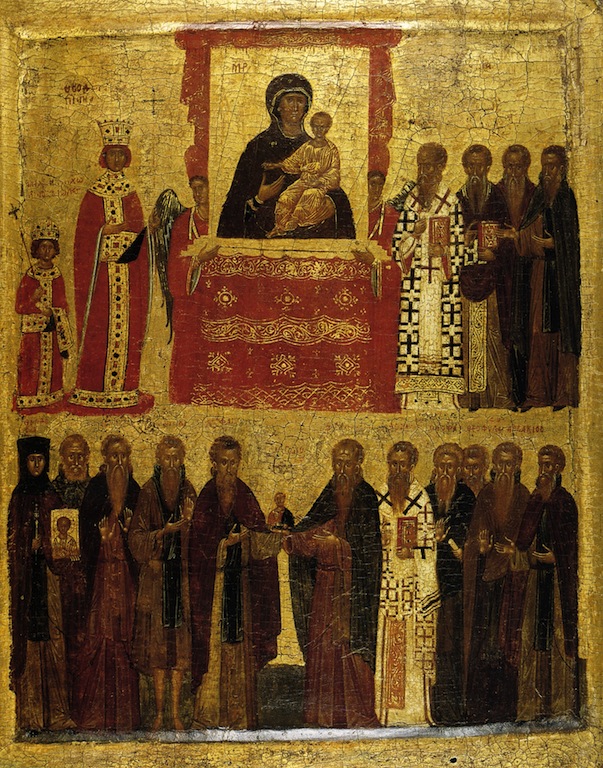
Icon of the Triumph of Orthodoxy. The Empress Regent Theodora and her infant son, the Emperor Michael III, are at the top left, St Methodius the Confessor, Patriarch of Constantinople, and monks at the top right. The Hodegetria icon (‘She Who Shows the Way’—the Holy Virgin showing us her Son, an icon believed to have been written originally by St Luke) is between them, held up by two angels. Below, bishops, monks and a nun hold up icons.
(Written c. 1400 and now in the collection of the British Museum. Image from Wikipedia in the public domain.)
 RSS Feed