The Council Meets
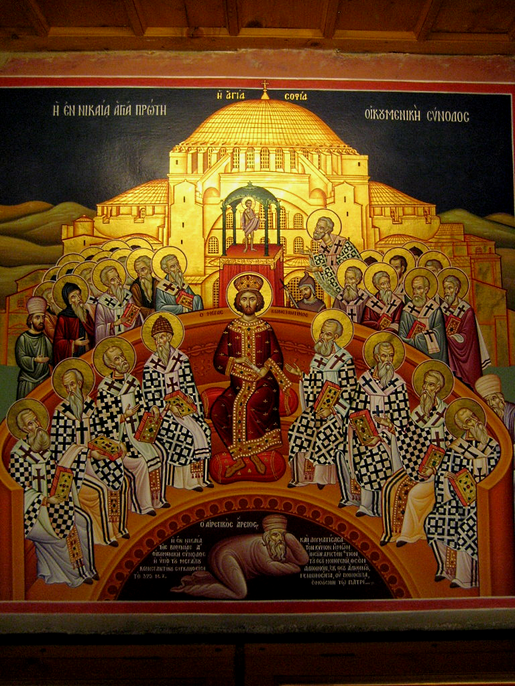
[Icon of the Council of Nicæa in the Great Meteoron Monastery, Kalambaka, Greece, showing Arius crouching beneath the Emperor Constantine. Photograph by Jjensen, 23 August 2008. Creative Commons Attribution-Share Alike 3.0 Unported license.]
The great and holy council of Nicæa opened in early or mid June and adjourned by 25 July in the year 325. It met at the command of the Emperor Constantine, who treated the bishops with the greatest respect and provided liberal assistance in transportation and maintenance for them and their followers. It must have been a heady experience for bishops more used to the lash from the imperial authorities—many of those attending the council bore on their bodies the scars of the persecution of Diocletian.
Of course we know what the council accomplished—the first version of the Nicene Creed, the anathematization of the teachings of Arius and the banishment of him and his followers, the fixing of the date of Easter, the resolution—attempted at least—of the Melitian schism. It decreed canons concerning church discipline, but the list we now have may have been associated with the council at a later date.
But we know surprisingly little else about it, in particular the sequence of events and how it carried out its debates. It would have been usual at a major conference attended by the emperor in person for the proceedings to be taken down by stenographers and published, and this in fact was done for subsequent œcumenical councils. But we have no evidence that it was done for this council, and the accounts of the church historians are so diverse in their treatment as to suggest that they were not working from an official document.
Even the dates of the council are uncertain. The traditional date for its opening is 20 May but this appears to be a slip by Socrates Scholasticus in reading the Latin date from a table of canons, and 25 August has been given as the date of its closing, although it seems improbable that the council’s deliberations could actually have needed three months. The dates cited above are those accepted by Barnes (Constantine and Eusebius, pp. 215 and 219). Five or six weeks seems a reasonable length for the conference. The questions it was debating could not have taken too much time and it is unlikely that the bishops would want to be away from their dioceses for much longer—or that Constantine would want to pay their room and board for much longer.
The only apparently objective account—and I emphasise the word ‘apparently’—that we have of the council’s proceedings by someone who was actually there, and also the earliest account, was written by Eusebius of Cæsarea and included in his Vita Constantini, written more than ten years later after the death of Constantine. But we know that Eusebius more than most had reason not to be candid about what happened at Nicæa. To read his account, you would never guess that he was there on trial for heresy. In fact he manages to give the impression that he and Constantine between them devised the council’s final creed, which we know was definitely not the case.
But the church historians, beginning with Eusebius of Cæsarea around 332 and going on to Hilary of Poitiers and St Athanasius the Great around 360, St Epiphanius of Salamis around 380, Rufinus of Aquileia around 400, Theodoret of Cyrrhus around 430, Socrates Scholasticus around 440 and Sozomen around 445, give us an idea of the principal events of the council, although not of their order, basing themselves on letters and eyewitness accounts—and, of course, Eusebius and Athanasius were present at the council.
First of all, how many bishops attended the council? The traditional number is 318, first attested by Hilary, who said, ‘I think the number sacred, for with such a number Abraham overcame the wicked kings, and was blessed by Him who is a type of the eternal priesthood,’ referring to the account in Genesis 14:14. (De Synodis, cap. 86, trans. E.W. Watson and L. Pullan, Nicene and Post-Nicene Fathers, Series 2, IX, 1899, from New Advent website, ed. Kevin Knight.) Epiphanius and Rufinus repeat the number but Eusebius in Vita Constantini said more than 250, while Socrates said more than 300 and Sozomen more than 320. The lack of agreement on the number is further evidence that there was no official record of the proceedings. But everyone was agreed that it was a great many, and that their accompanying priests, deacons, advisers and servants were still more numerous. Something like two thousand visitors must have crowded into Nicæa, all supported at public expense.
They came mostly from the eastern and Balkan provinces of the Roman empire, although there were a few from the west, including of course Constantine’s ecclesiastical adviser, Hosius of Cordova, and also Cecilianus of Carthage. A single bishop from Gaul attended, Nicasius of Die. Die is now a small commune in the mountains of the Drôme department in France. Its history goes back to the neolithic but the most exciting thing that seems ever to have happened there was its bishop’s attendance at the Council of Nicæa. There were even present two bishops from beyond the Roman frontiers, a bishop from Persia and one from the Goths. The bishop of Rome, Sylvester, was too old to make the journey but sent as delegates the priests Vitus and Vincent. St Alexander of Alexandria, St Eustathius of Antioch and Marcellus of Ancyra were present at the head of the orthodox while Eusebius of Nicomedia, Maris of Chalcedon and Theognius, the bishop of Nicæa itself, were present at the head of the Arian faction.
We know the principal events of the council. Obviously the most important was the examination of Arius and the debate on his and his followers’ doctrines, but almost nothing is said of them except that they happened. We also know, almost by chance, that Eusebius of Cæsarea, Theodotus of Laodicea and Narcissus of Neronias were required to clear themselves of the suspicion of having shared Arius’s views. We know that the date of Easter was discussed, although presumably briefly, as it was not a doctrinal issue, rather a matter of local custom. We know that the Melitian schism was discussed, although it seems that no Melitian bishops were present.
And of course there were the formal speeches. We have Constantine’s opening address to the council, although no agreement on when exactly it was delivered. We also have his closing words, spoken at the great banquet that he gave for the departing bishops. This banquet assures us of the closing date of the council, since he gave it in celebration of the beginning of the twentieth year of his reign.
There are also some curious things, well attested so they must have occurred, but that are difficult to fit into any coherent account of the council.
First, it seems that a good many rhetoricians, mostly pagan, were present in Nicæa, apparently ready to offer their professional services as advocate to any bishop who needed them, but what role they actually played, if any, is unknown. Their presence is interesting because of the role that dialectic and its abuse were widely believed to have played in the spread of the Arian heresy. The rhetoricians may have served simply as a literary device to contrast pagan sophistry with Christian simplicity.
Second is the subject of the petitions. This could well have happened but has more the air of a parable. The bishops assembling in the presence of the emperor took advantage of the occasion to petition him for redress against injuries they felt they had received from their brother bishops. Constantine collected the petitions and in formal session announced that the bishops should forgive each other and forego dispute, that a greater judge than he would weigh their complaints, and then had the petitions burnt unread.
Eusebius of Cæsarea describes the opening of the council and gives Constantine’s welcoming speech:
‘Now when the appointed day arrived … each member was present for this in the central building of the palace … On each side of the interior of this were many seats disposed in order, which were occupied by those who had been invited to attend, according to their rank.
‘As soon, then, as the whole assembly had seated themselves with becoming orderliness, a general silence prevailed, in expectation of the emperor’s arrival. And first of all, three of his immediate family entered in succession, then others also preceded his approach, not of the soldiers or guards who usually accompanied him but only friends in the faith. And now, all rising at the signal which indicated the emperor’s entrance, at last he himself proceeded through the midst of the assembly …
‘As soon as he had advanced to the upper end of the seats, at first he remained standing and when a low chair of wrought gold had been set for him, he waited until the bishops had beckoned to him and then sat down and after him the whole assembly did the same.
‘The bishop who occupied the chief place in the right division of the assembly [we assume it was Eusebius of Nicomedia, the metropolitan bishop of the province] then rose and, addressing the emperor, delivered a concise speech, in a strain of thanksgiving to Almighty God on his behalf. When he had resumed his seat, silence ensued and all regarded the emperor with fixed attention; on which he looked serenely round on the assembly with a cheerful aspect and, having collected his thoughts, in a calm and gentle tone gave utterance to the following words.
‘ ‘… I pray that, now the impious hostility of the tyrants has been forever removed by the power of God our Saviour [referring to the civil war just concluded], that spirit who delights in evil may devise no other means for exposing the divine law to blasphemous calumny; for, in my judgement, intestine strife within the Church of God is far more evil and dangerous than any kind of war or conflict …
‘ ‘… but I feel that my desires will be most completely fulfilled when I can see you all united in one judgement and that common spirit of peace and concord prevailing among you all …’ (Vita Constantini, III, x–xii; trans. E.C. Richardson, Nicene and Post-Nicene Fathers, Series 2, I, 1890, from New Advent website, ed. Kevin Knight.)
Constantine spoke in Latin, as was appropriate for a formal address, with an interpreter, but Eusebius tells us that he could speak Greek and engaged the bishops in informal discussion in their own language.
Eusebius goes on to imply that Constantine took part in the examination of Arius’s views, and indeed, that Constantine and Eusebius himself between them resolved all the outstanding issues. Sozomen has a different and more likely account (Ecclesiastical History, I, xvii, 5–7), that the emperor fixed a day when the issues facing the council would be resolved. The inquiry into Arius and his doctrines then took place before this date in the absence of the emperor. Sozomen then places what Eusebius gives as Constantine’s opening speech at the session where a final decision was to be reached. (I, xx, 1–3) This fits in better with the account of the debate that Athanasius gives, that we will come to in a moment, although that account was written several decades later and is theological, not verbatim.
We know that the Council of Antioch had ordered Eusebius of Cæsarea, Theodotus of Laodicea and Narcissus of Neronias to clear themselves of the suspicion of unorthodoxy at the Council of Nicæa but no direct evidence of this is found in the church historians. Eusebius himself, however, tells us that he submitted a confession of faith to the council, which we find in the letter he wrote to his diocese at the end of the council, reproduced by Theodoret, and this must have been his defence. In it he takes care to avoid any of the catchphrases associated with Arius, but he also avoids any use of the term οὐσία. Its concluding sentences show him clearly pleading his orthodoxy: ‘We positively affirm that we hold this faith, that we have always held it, and that we adhere to it even unto death, condemning all ungodly heresy. We testify, as before God the Almighty and our Lord Jesus Christ, that we have thought thus from the heart, and from the soul, ever since we have known ourselves; and we have the means of showing, and, indeed, of convincing you, that we have always during the past thus believed and preached.’ (Theodoret, Ecclesiastical History, I, xi; trans. Blomfield Jackson, Nicene and Post-Nicene Fathers, 2nd series, III, 1892, p. 49) The plea was evidently successful.
There is evidence that Narcissus of Neronias was less successful. Theodoret tells us that ‘Menophantus, bishop of Ephesus, Patrophilus, bishop of Scythopolis, Theognius, bishop of Nicæa, and Narcissus, bishop of Neronias … also Theonas, bishop of Marmarica, and Secundus, bishop of Ptolemais in Egypt … drew up a formulary of their faith and presented it to the council. As soon as it was read it was torn to pieces, and was declared to be spurious and false. So great was the uproar raised against them, and so many were the reproaches cast on them for having betrayed religion, that they all, with the exception of Secundus and Theonas, stood up and took the lead in publicly renouncing Arius.’ (ibid. I, vi; p. 44) We hear nothing of Theodotus of Laodicea.
Athanasius, present at the council as a deacon with St Alexander of Alexandria, gives a vivid account of the debate on Arius’s views in his letter to the Africans, written 44 years later and quoted by Theodoret:
‘The bishops convened in council, being desirous of refuting the impious assertions invented by the Arians, that the Son was created out of that which was non-existent, that He is a creature and created being, that there was a period in which He was not, and that He is mutable by nature, and being all agreed in propounding the following declarations, which are in accordance with the holy Scriptures; namely, that the Son is by nature only-begotten of God, Word, Power, and sole Wisdom of the Father; that He is, as John said, ‘the true God,’ [1 Jn. 5:20] and, as Paul has written, ‘the brightness of the glory, and the express image of the person of the Father,’ [Heb. 1:3] the followers of Eusebius [of Nicomedia], drawn aside by their own vile doctrine, then began to say one to another, ‘Let us agree, for we are also of God—[quoting] ‘There is but one God, by whom are all things;’ [1 Cor. 8:6] ‘Old things are passed away; behold, all things are become new, and all things are of God’.’ [2 Cor. 5:17, 18] They also dwelt particularly upon what is contained in the Shepherd of Hermas: ‘Believe above all that there is one God, who created and fashioned all things, and making them to be out of that which is not.’
‘But the bishops saw through their evil design and impious artifice, and gave a clearer elucidation of the words ‘of God,’ [ἐκ τοῦ Θεοῦ] and wrote that the Son is ‘of the substance of God’ [ἐκ τῆς οὐσίας τοῦ Θεοῦ]; in order that while the creatures, which do not in any way derive their existence of or from themselves, are said to be of God, the Son alone is said to be of the substance of the father; this being peculiar to the only-begotten Son, the true Word of the Father. This is the reason why the bishops wrote that He is of the substance of the Father.
‘But when the Arians, who seemed few in number, were again interrogated by the bishops as to whether they admitted that the Son is not a creature, but Power, and sole Wisdom, and eternal unchangeable Image of the Father; and that He is very God, the Eusebians were noticed making signs to one another to show that these declarations were equally applicable to us [human beings]. For it is said, that we are ‘the image and glory of God’; [1 Cor. 11:7] and ‘for always we who live’; {2 Cor. 4:11] there are, also, they said, many powers; for it is written, ‘All the power of God went out of the land of Egypt.’ [Ex. 12:41] The canker-worm and locust are said to be ‘a great power.’ [Joel 2:25] And elsewhere it is written, ‘The God of powers is with us, the God of Jacob is our helper.’ [Ps. 45:8 LXX] To which may be added that we are God’s own not simply, but because the Son called us ‘brethren.’ [Heb. 2:11] ‘The declaration that Christ is ‘the true God’ does not distress us, [they said,] for, having come into being, He is true.’
‘Such was the corrupt opinion of the Arians; but on this the bishops, having detected their deceitfulness in this matter, collected from scripture those passages which say of Christ that He is the glory, the fountain, the stream, and the express image of the person [χαρακτῆρα πρὸς τὴν ὑπόστασιν]; and they quoted the following words: ‘In thy light we shall see light;’ [Ps. 36:10 LXX] and likewise, ‘I and the Father are one.’ [Jn 10:30] They then, with still greater clearness, briefly declared that the Son is of one substance with the Father [ὁμοούσιον τῷ Πατρὶ τὸν Υἱόν]; for this, indeed, is the signification of the passages which have been quoted.
‘The complaint of the Arians, that these precise words are not to be found in Scripture, is proved groundless by their own practice, for their own impious assertions are not taken from Scripture; for it is not written that the Son is of the non-existent, and that there was a time when He was not; and yet they complain of having been condemned by expressions which, though not actually in Scripture, are in accordance with true religion … The bishops, on the contrary, did not find their expressions for themselves; but, received their testimony from the fathers, and wrote accordingly. Indeed, there were bishops of old time, nearly one hundred and thirty years ago, both of the great city of Rome and of our own city, who condemned those who asserted that the Son is a creature [ποίημα λέγοντας τὸν Υἱὸν], and that He is not of one substance with the Father [μὴ ὁμοούσιον τῷ Πατρί—allusion possibly to Dionysius of Rome and Dionysius of Alexandria].
‘Eusebius, the bishop of Cæsarea, was acquainted with these facts; he, at one time, favoured the Arian heresy, but he afterwards signed the confession of faith of the Council of Nicæa. He wrote to the people of his diocese, maintaining that the word ‘consubstantial’ [ὁμοούσιον] was ‘used by illustrious bishops and learned writers as a term for expressing the divinity of the Father and of the Son’.
‘So these men concealed their unsoundness through fear of the majority, and gave their assent to the decisions of the council … Theonas and Secundus, however, did not like to take this course, and were excommunicated by the common consent as men who esteemed the Arian blasphemy above evangelical doctrine.’ (Ibid., I, vii; pp.44–46; Migne PG 82, col. 921, 924, 925.)
Sozomen describes what happened on the day fixed for the resolution of all questions following the examination of Arius. The bishops met in the presence of Constantine, who listened to both sides, pacifying the disputatious and encouraging agreement and concord, charming everyone with his fluency in Greek. ‘At the end all the bishops reached agreement and voted that the Son is of the same essence as the Father [ὁμοούσιον εἶνα τῷ πατρὶ τὸν υἱὸν ἐψηφίσαντο]. It is said that at the beginning there were only seventeen fathers to support the thesis of Arius, but that, right away, most of these fathers sided with the general opinion. The emperor himself joined his vote to this decision … He ordered that those who went against the decisions taken should be exiled …’ (Sozomen, Ecclesiastical History, I, xx, 1-2; Sources chrétiennes, 306, trans. André-Jean Festugière, pp. 203-07.)
‘The result was that they were not only united as concerning the faith but that the time for the celebration of the salutary feast of Easter was agreed on by all. Those points also which were sanctioned by the resolution of the whole body were committed to writing and received the signature of each several member.’ (Vita Constantini, III, xiv.)
The creed proclaimed by the bishops was as follows:
‘We believe in one God, Father Almighty, maker of all things visible and invisible.
‘And in one Lord Jesus Christ, the Son of God, begotten of the Father, only-begotten, that is, of the substance of the Father [τουτέστιν ἐκ τῆς οὐσίας τοῦ Πατρὸς], God of God, Light of Light, very God of very God, begotten not made, being of one substance with the Father [ὁμοούσιον τῷ Πατρί]:
‘By whom all things were made both in heaven and on earth: Who for us men [τὸν δι’ ἡμᾶς τοὺς ἀνθρώπους], and for our salvation, came down from heaven, and was incarnate, and was made man [καὶ ἐνανθρωπήσαντα];
‘He suffered, and rose again the third day; he ascended into heaven, and is coming to judge both living and dead.
‘And we believe in the Holy Spirit.’
There follow the anathemas of the teachings of Arius:
‘The holy, catholic and apostolic Church anathematizes all who say of the Son of God that there was a time when he was not [ἦν ποτε ὅτε οὐκ ἦν]; that before he was begotten he was not [πρὶν γεννηθῆναι οὐκ ἦν]; that he was made out of the non-existent [ἐξ οὐκ ὄντων ἐγένετο]; or that he is of a different subsistence or of a different essence [ἐξ ἑτέρας ὑποστάσεως ἢ οὐσίας]; and that he is susceptible of variation or change [εἶναι τρεπτὸν ἢ ἀλλοιωτόν].’ (Theodoret, op. cit., I, xi; p. 50; Migne PG 82, cols. 941, 944.)
Of the leaders of the Arian party, Eusebius of Nicomedia, Theognius of Nicæa, Maris of Chalcedon, Patrophilus of Scythopolis, Paulinus of Tyr, Secundus of Ptolemais and Theonas of Marmarica, all but the last two dissimulated their Arian convictions and signed the Creed. Eusebius and Theognius, however, refused to sign the excommunication of Arius. Secundus and Theonas, both of them bishops of Libya, refused to sign the Creed and were deposed and banished. Arius with the presbyters and deacons who had joined his party were exiled to Illyria and his writings were ordered burnt.
On the question of the celebration of Easter, the council did not prescribe how to calculate the date, merely declared that it should be the same everywhere, and more particularly the same as at Rome and Alexandria.
The 25th of July marked the beginning of the twentieth year of Constantine’s reign. He celebrated by hosting a great feast for the assembled clergy. It must have been a surreal experience for the bishops who had formerly been subjected to imprisonment and torture. Eusebius of Cæsarea, who was present, gives us an account:
‘… Detachments of the bodyguard and other troops surrounded the entrance of the palace with drawn swords and through the midst of these the men of God proceeded without fear into the innermost of the imperial apartments, in which some were the emperor’s own companions at table, while others reclined on couches arranged on either side. One might have thought that a picture of Christ’s kingdom was thus shadowed forth and a dream rather than reality.
‘After the celebration of this brilliant festival, the emperor courteously received all his guests and generously added to the favours he had already bestowed by personally presenting gifts to each individual according to his rank …’ (Vita Constantini, III, xv–xvi)
And so the great and holy Council of Nicæa concluded.
The bishops of the council wrote a letter to the diocese most concerned with the Arian controversy, the Church of Alexandria, summarising their conclusions. They related the condemnation of Arius’s teachings and the banishment of Arius and his followers and of Secundus and Theonas, then went on to the council’s decisions regarding the Melitian schism, which they dealt with at some length: Melitius was allowed to remain in Lycopolis and to retain the title of bishop but was forbidden to exercise the jurisdiction. Those irregularly ordained by him were required to have their ordination perfected by an orthodox bishop, and those he had ordained bishops were reduced to presbyters. It then mentioned briefly the decision fixing the date of Easter. (Theodoret, Ecclesiastical History, I, viii; Socrates Scholasticus, Ecclesiastical History, I, ix, 2–4.)
Constantine himself wrote a letter to the Church of Alexandria:
‘I convoked in the city of Nicæa most of the bishops; with them, as one among you, I also your fellow servant, which I much rejoice in being, I myself undertook the search for the truth. One thus examined and tested with the closest attention everything that seemed to give rise to controversy or dissent. May the divine magnificence be mild, however great and terrible were the blasphemies that certain made public in an unseemly manner on our great Saviour, our hope and our life, by affirming certain things contrary to the God-inspired Scriptures and the holy faith and confessing that they believed them. Now that more than three hundred bishops … have confirmed one only same faith, which is, by the truth and precision of the divine law, the authentic faith, only Arius was convicted of having been seduced by diabolical influence and having spread the evil with an impious intention first among you, later among others. Receive then this sentence that the All Powerful has proposed to us, let us rejoin our beloved brethren whom an impudent servant of the devil has separated us from, let us go with all our heart toward our common body and our true members.’ [Socrates Scholasticus, op. cit., I, ix, 19–22 (trans. Pierre Périchon and Pierre Maraval, Sources chrétiennes, pp. 121, 123) And in §§ 23–25 he exhorts them to accept the decision of the council and refrain from discord—in the transcript by Socrates there is no mention of Easter.]
Constantine also wrote to the bishops who had been unable to attend the council. In writing to Alexandria, Constantine could not avoid mentioning Arius, but in writing to the other bishops, he manages to avoid mentioning him by name; in fact the debates that had occupied the council for more than a month are summarised in a few sentences, emphasising the concord and unity achieved, ‘so that no room should remain for division or controversy concerning the faith.’ (Ibid., I, ix, 32–46; Sources chrétiennes, pp. 127, 129, 131, 133)
He then goes on to the agreement achieved on the celebration of Easter: ‘… since that arrangement is consistent with propriety which is observed by all the churches of the western, southern and northern parts of the world and by some of the eastern also: for these reasons all are unanimous on this present occasion in thinking it worthy of adoption … your Wisdoms will gladly admit that practice which is observed at once in the city of Rome and in Africa; throughout Italy and in Egypt, in Spain, the Gauls, Britain, Libya and the whole of Greece; in the dioceses of Asia and Pontus and in Cilicia, with entire unity of judgement …’ (Vita Constantini, III, xix)
And this subject, one he could celebrate without reservation, takes up nine-tenths of the letter.
Note that the emperor makes it clear whenever he intervenes in the debate that what he wants is peace, harmony, unity, and the absence of controversy and disputation. Obviously he would prefer that the whole Arian quarrel should simply vanish. And this may be the reason for the puzzling absence, noted earlier, of any official account of the proceedings. It may well be that Constantine personally ordered that no stenographic record should be made in order that the whole unhappy episode might be the sooner forgotten.